Run this notebook
This notebook walks through a simple, novice-friendly workflow in Neurodesk EDU:
install one OpenNeuro dataset and get one subject
run fMRIPrep for one task/run from that subject and extract FEAT-ready confounds
convert BIDS
events.tsvfiles to FSL 3-column EV filesrender and run a first-level FEAT model from a trust-game FEAT template
make a first pass at viewing the result in NiiVue
<a href="https://orcid.org/0000-0001-5754-9633" target="_blank" style="color: #0066cc;">
    <i class="fab fa-orcid"></i> David V. Smith
</a>Date: April 2, 2026
License:
MIT LicenseProvenance: This notebook adapts course materials and selected logic from the Fareri trust-game workflow code, but rewrites the steps so they can be followed directly in notebook cells. Full workflow repository: tubric
Acknowledgments: This notebook was generated with assistance from ChatGPT-5 across several iterations and then revised by the instructor. The instructor reviewed the final content and takes responsibility for it.
Citation and Resources
Study-specific references
Fareri et al. (2022): Fareri, D. S., Hackett, K., Tepfer, L. J., Kelly, V., Henninger, N., Reeck, C., Giovannetti, T., & Smith, D. V. (2022). Age-related differences in ventral striatal and default mode network function during reciprocated trust. NeuroImage, 256, 119267. Fareri et al. (2022)
Smith et al. (2024): Smith, D. V., Ludwig, R. M., Dennison, J. B., Reeck, C., & Fareri, D. S. (2024). An fMRI Dataset on Social Reward Processing and Decision Making in Younger and Older Adults. Scientific Data, 11(1), 158. https://
doi .org /10 .1038 /s41597 -024 -02931-y
Full workflow repository
Fareri trust-game workflow repo: https://
github .com /tubric /fareri -2022 -neuroimage
Tools included in this workflow
fMRIPrep: Esteban, O., Markiewicz, C. J., Blair, R. W., et al. (2019). fMRIPrep: a robust preprocessing pipeline for functional MRI. Nature Methods, 16, 111–116.
FSL / FEAT: Jenkinson, M., Beckmann, C. F., Behrens, T. E. J., Woolrich, M. W., & Smith, S. M. (2012). FSL. NeuroImage, 62, 782–790.
DataLad: Halchenko, Y. O., Meyer, K., Poldrack, B., et al. (2021). DataLad: distributed system for joint management of code, data, and their relationship. Journal of Open Source Software, 6, 3262.
bidsutils /
BIDSto3col.sh: Tom Nichols and contributors.bids-standard/bidsutils.NiiVue / ipyniivue for interactive image viewing in Jupyter.
Dataset
OpenNeuro ds003745 (trust game dataset used in class materials and labs)
Educational resources
Course labs on Neurodesk, fMRIPrep, FEAT, and 3-column event files.
Table of content
1. Load software tools and import python libraries
2. Data preparation
3. Run fMRIPrep for one selected run
4. Make a FEAT confounds file
5. Convert events.tsv to 3-column files
6. Render the FEAT template
7. Run first-level FEAT
8. Fix FEAT registration for fMRIPrep-preprocessed data
9. Results
10. Dependencies in Jupyter/Python
1. Load software tools and import python libraries
import module
await module.load('fmriprep/25.2.5')
await module.load('fsl/6.0.7.22')
await module.list()
['fmriprep/25.2.5', 'fsl/6.0.7.22']%%capture
!pip install pandasfrom pathlib import Path
import os
import glob
import pandas as pd
from IPython.display import display, Markdown, Image
base_dir = Path.home() / "trust_example"
print(base_dir)/home/jovyan/trust_example
2. Data preparation
We will keep everything for this example in one folder directly under the home directory:
~/trust_example
That makes the paths easy to read, and it also makes it easier to rerun or delete the whole example later if you want a clean start.
Inside that folder, we will make a few subdirectories:
templates/for the FEAT templatebids/for the OpenNeuro datasetderivatives/for fMRIPrep output, confounds, EV files, and FEAT outputscratch/for temporary working filesbidsutils/for Tom Nichols’BIDSto3col.sh
%%bash
set -euo pipefail
# Retry transient network failures, then fail the cell instead of continuing without data.
retry() { for i in 1 2 3 4 5; do "$@" && return 0; echo "Attempt $i failed: $*" >&2; [ "$i" -lt 5 ] && sleep $((i * 15)); done; return 1; }
EXAMPLE_DIR="$HOME/trust_example"

mkdir -p "$EXAMPLE_DIR"
cd "$EXAMPLE_DIR"

# Keep the example organized in one project folder.
mkdir -p templates bids derivatives scratch

# Copy the one FEAT template we need.
curl -L \
  https://raw.githubusercontent.com/tubric/fareri-2022-neuroimage/main/templates/L1_task-trust_model-01_type-act.fsf \
  -o templates/L1_task-trust_model-01_type-act.fsf

# Install bidsutils separately so we can use BIDSto3col.sh.
if [ ! -d bidsutils ]; then
  git clone --depth 1 https://github.com/bids-standard/bidsutils.git
fi

# Install the OpenNeuro dataset skeleton and get the full subject recursively.
cd bids
if [ ! -d ds003745 ]; then
  retry datalad install https://github.com/OpenNeuroDatasets/ds003745.git
fi

cd ds003745
retry datalad get -r sub-104
  % Total    % Received % Xferd  Average Speed   Time    Time     Time  Current
                                 Dload  Upload   Total   Spent    Left  Speed
100 73223  100 73223    0     0   211k      0 --:--:-- --:--:-- --:--:--  210k
Cloning into 'bidsutils'...
[INFO] Attempting a clone into /home/jovyan/trust_example/bids/ds003745
[INFO] Attempting to clone from https://github.com/OpenNeuroDatasets/ds003745.git to /home/jovyan/trust_example/bids/ds003745
[INFO] Start enumerating objects
[INFO] Start counting objects
[INFO] Start compressing objects
[INFO] Start receiving objects
[INFO] Start resolving deltas
[INFO] Completed clone attempts for Dataset(/home/jovyan/trust_example/bids/ds003745)
[INFO] Remote origin not usable by git-annex; setting annex-ignore
[INFO] https://github.com/OpenNeuroDatasets/ds003745.git/config download failed: Not Found
[INFO] access to 1 dataset sibling s3-PRIVATE not auto-enabled, enable with:
| 		datalad siblings -d "/home/jovyan/trust_example/bids/ds003745" enable -s s3-PRIVATE
[INFO] Ensuring presence of Dataset(/home/jovyan/trust_example/bids/ds003745) to get /home/jovyan/trust_example/bids/ds003745/sub-104
install(ok): /home/jovyan/trust_example/bids/ds003745 (dataset)
get(ok): sub-104/anat/sub-104_T1w.nii.gz (file) [from s3-PUBLIC...]
get(ok): sub-104/anat/sub-104_T2w.nii.gz (file) [from s3-PUBLIC...]
get(ok): sub-104/fmap/sub-104_magnitude1.nii.gz (file) [from s3-PUBLIC...]
get(ok): sub-104/fmap/sub-104_magnitude2.nii.gz (file) [from s3-PUBLIC...]
get(ok): sub-104/fmap/sub-104_phasediff.nii.gz (file) [from s3-PUBLIC...]
get(ok): sub-104/func/sub-104_task-sharedreward_run-01_bold.nii.gz (file) [from s3-PUBLIC...]
get(ok): sub-104/func/sub-104_task-sharedreward_run-02_bold.nii.gz (file) [from s3-PUBLIC...]
get(ok): sub-104/func/sub-104_task-trust_run-01_bold.nii.gz (file) [from s3-PUBLIC...]
get(ok): sub-104/func/sub-104_task-trust_run-02_bold.nii.gz (file) [from s3-PUBLIC...]
get(ok): sub-104/func/sub-104_task-trust_run-03_bold.nii.gz (file) [from s3-PUBLIC...]
get(ok): sub-104/func/sub-104_task-trust_run-04_bold.nii.gz (file) [from s3-PUBLIC...]
get(ok): sub-104/func/sub-104_task-trust_run-05_bold.nii.gz (file) [from s3-PUBLIC...]
get(ok): sub-104/func/sub-104_task-ultimatum_run-01_bold.nii.gz (file) [from s3-PUBLIC...]
get(ok): sub-104/func/sub-104_task-ultimatum_run-02_bold.nii.gz (file) [from s3-PUBLIC...]
get(ok): sub-104 (directory)
action summary:
  get (ok: 15)
!tree -L 3 ~/trust_example/templates
!tree -L 3 ~/trust_example/bids/ds003745/sub-104
/home/jovyan/trust_example/templates
└── L1_task-trust_model-01_type-act.fsf
1 directory, 1 file
/home/jovyan/trust_example/bids/ds003745/sub-104
├── anat
│ ├── sub-104_T1w.json
│ ├── sub-104_T1w.nii.gz -> ../../.git/annex/objects/wM/31/MD5E-s8381149--5fd51ee8f8b1d0fa00490acab7054f44.nii.gz/MD5E-s8381149--5fd51ee8f8b1d0fa00490acab7054f44.nii.gz
│ ├── sub-104_T2w.json
│ └── sub-104_T2w.nii.gz -> ../../.git/annex/objects/Z3/xJ/MD5E-s9405965--d643b78dc1b963c582be22a5e67576c5.nii.gz/MD5E-s9405965--d643b78dc1b963c582be22a5e67576c5.nii.gz
├── fmap
│ ├── sub-104_magnitude1.json
│ ├── sub-104_magnitude1.nii.gz -> ../../.git/annex/objects/5p/kK/MD5E-s227307--ff542908f56f6acec5e8ef22a84ec4b2.nii.gz/MD5E-s227307--ff542908f56f6acec5e8ef22a84ec4b2.nii.gz
│ ├── sub-104_magnitude2.json
│ ├── sub-104_magnitude2.nii.gz -> ../../.git/annex/objects/fz/8J/MD5E-s225256--6926b13a836ec3487bb68649bf0f36cb.nii.gz/MD5E-s225256--6926b13a836ec3487bb68649bf0f36cb.nii.gz
│ ├── sub-104_phasediff.json
│ └── sub-104_phasediff.nii.gz -> ../../.git/annex/objects/Qw/1v/MD5E-s315320--78621dbba52c9bf69a344e60e82a7c57.nii.gz/MD5E-s315320--78621dbba52c9bf69a344e60e82a7c57.nii.gz
├── func
│ ├── sub-104_task-sharedreward_run-01_bold.json
│ ├── sub-104_task-sharedreward_run-01_bold.nii.gz -> ../../.git/annex/objects/8G/Jk/MD5E-s46088562--9731c3b106760361503f64a140d31914.nii.gz/MD5E-s46088562--9731c3b106760361503f64a140d31914.nii.gz
│ ├── sub-104_task-sharedreward_run-01_events.tsv
│ ├── sub-104_task-sharedreward_run-02_bold.json
│ ├── sub-104_task-sharedreward_run-02_bold.nii.gz -> ../../.git/annex/objects/F7/ZF/MD5E-s46094097--51993b075ce4576cf7d9f87af3ed87fb.nii.gz/MD5E-s46094097--51993b075ce4576cf7d9f87af3ed87fb.nii.gz
│ ├── sub-104_task-sharedreward_run-02_events.tsv
│ ├── sub-104_task-trust_run-01_bold.json
│ ├── sub-104_task-trust_run-01_bold.nii.gz -> ../../.git/annex/objects/qQ/Wf/MD5E-s49583622--5df9c6e76342f61d119f834930f1b106.nii.gz/MD5E-s49583622--5df9c6e76342f61d119f834930f1b106.nii.gz
│ ├── sub-104_task-trust_run-01_events.tsv
│ ├── sub-104_task-trust_run-02_bold.json
│ ├── sub-104_task-trust_run-02_bold.nii.gz -> ../../.git/annex/objects/Zx/1g/MD5E-s49598762--8064d7bae979bf7dce903a5d9566c179.nii.gz/MD5E-s49598762--8064d7bae979bf7dce903a5d9566c179.nii.gz
│ ├── sub-104_task-trust_run-02_events.tsv
│ ├── sub-104_task-trust_run-03_bold.json
│ ├── sub-104_task-trust_run-03_bold.nii.gz -> ../../.git/annex/objects/wg/zf/MD5E-s49517139--ab7192041bf89d0090c5073efde94d35.nii.gz/MD5E-s49517139--ab7192041bf89d0090c5073efde94d35.nii.gz
│ ├── sub-104_task-trust_run-03_events.tsv
│ ├── sub-104_task-trust_run-04_bold.json
│ ├── sub-104_task-trust_run-04_bold.nii.gz -> ../../.git/annex/objects/7j/Z7/MD5E-s49498400--842108100e1e9e1ba319befbf607a742.nii.gz/MD5E-s49498400--842108100e1e9e1ba319befbf607a742.nii.gz
│ ├── sub-104_task-trust_run-04_events.tsv
│ ├── sub-104_task-trust_run-05_bold.json
│ ├── sub-104_task-trust_run-05_bold.nii.gz -> ../../.git/annex/objects/2z/m5/MD5E-s49530982--83aa67c0eeb97763f1a9ed2fed446f5f.nii.gz/MD5E-s49530982--83aa67c0eeb97763f1a9ed2fed446f5f.nii.gz
│ ├── sub-104_task-trust_run-05_events.tsv
│ ├── sub-104_task-ultimatum_run-01_bold.json
│ ├── sub-104_task-ultimatum_run-01_bold.nii.gz -> ../../.git/annex/objects/px/3W/MD5E-s45649089--6c0c75aa15a19bd42fa34aa85f86364c.nii.gz/MD5E-s45649089--6c0c75aa15a19bd42fa34aa85f86364c.nii.gz
│ ├── sub-104_task-ultimatum_run-01_events.tsv
│ ├── sub-104_task-ultimatum_run-02_bold.json
│ ├── sub-104_task-ultimatum_run-02_bold.nii.gz -> ../../.git/annex/objects/mx/Qg/MD5E-s45657152--c4ca6e2d5208031fd9aaf4a8735692a2.nii.gz/MD5E-s45657152--c4ca6e2d5208031fd9aaf4a8735692a2.nii.gz
│ └── sub-104_task-ultimatum_run-02_events.tsv
├── sub-104_scans.json
└── sub-104_scans.tsv
4 directories, 39 files
The example below uses:
subject:
104task:
trustrun:
01
That keeps the notebook manageable, but the same logic can be repeated for the other runs.
For teaching purposes, one run is a nice compromise: the model is still realistic, but the files and paths stay simple enough to follow line by line.
3. Run fMRIPrep for one selected run
The next cell runs fMRIPrep on one participant for the trust task and run 01. It writes the outputs under ~/trust_example/derivatives/fmriprep.
The task is selected with --task-id trust. The --bids-filter-file narrows fMRIPrep’s BOLD-file query to run-01, so the example processes only the run used later by FEAT.
A few practical notes:
the FreeSurfer license file should exist at
~/.licensethis command will likely take a couple of hours to run
if you are wondering whether it is still running, go back to the Terminal and type
topthe
antsRegistrationstep is especially slow, so long stretches of apparent inactivity are normalwe use
MNI152NLin6Asym:res-2so the preprocessed BOLD file lands on a 2 mm MNI grid that is easy to use alongside standard FSL templates and atlases
One important detail: the res-2 part controls the output grid of the resampled BOLD files. It does not change the resolution used for the underlying nonlinear normalization.
# Request a freesurfer license and store it in your homedirectory.
# This is just an example - please replace with your license id:
!echo "Steffen.Bollmann@cai.uq.edu.au" > ~/.license
!echo "21029" >> ~/.license
!echo "*Cqyn12sqTCxo" >> ~/.license
!echo "FSxgcvGkNR59Y" >> ~/.license
!ls -l ~/.license-rw-rw-r-- 1 jovyan jovyan 65 Oct 8 15:36 /home/jovyan/.license
%%bash
set -e

EXAMPLE_DIR="$HOME/trust_example"

sub=104
BIDS_DIR="$EXAMPLE_DIR/bids/ds003745"
OUT_DIR="$EXAMPLE_DIR/derivatives/fmriprep"
WORK_DIR="$EXAMPLE_DIR/scratch/fmriprep_work"
BIDS_FILTER="$EXAMPLE_DIR/scratch/bids_filter_task-trust_run-01.json"
FS_LIC="$HOME/.license"

mkdir -p "$OUT_DIR" "$WORK_DIR"

cat > "$BIDS_FILTER" <<'JSON'
{
  "bold": {
    "datatype": "func",
    "suffix": "bold",
    "run": "01"
  }
}
JSON

mkdir -p "$HOME/freesurfer-subjects-dir"
export SUBJECTS_DIR="$HOME/freesurfer-subjects-dir"

# This command will likely take a couple of hours to finish.
# If you want to confirm that it is still running, go back to the
# Terminal and type: top
# The antsRegistration process is especially slow and can run for
# a long time without printing much new output.

fmriprep \
  "$BIDS_DIR" \
  "$OUT_DIR" \
  participant \
  --participant-label "$sub" \
  --task-id trust \
  --bids-filter-file "$BIDS_FILTER" \
  --stop-on-first-crash \
  --fs-license-file "$FS_LIC" \
  --fs-subjects-dir "$SUBJECTS_DIR" \
  --fs-no-reconall \
  --output-spaces MNI152NLin6Asym:res-2 \
  -w "$WORK_DIR"
You are using fMRIPrep-25.2.5, and a newer version of fMRIPrep is available: 25.2.6.
Please check out our documentation about how and when to upgrade:
https://fmriprep.readthedocs.io/en/latest/faq.html#upgrading
(node:1605) Warning: Closing directory handle on garbage collection
(Use `node --trace-warnings ...` to show where the warning was created)
Downloading https://templateflow.s3.amazonaws.com/tpl-MNI152NLin6Asym/tpl-MNI152NLin6Asym_res-01_T1w.nii.gz
100%|██████████| 11.0M/11.0M [00:02<00:00, 5.47MB/s]
Downloading https://templateflow.s3.amazonaws.com/tpl-MNI152NLin6Asym/tpl-MNI152NLin6Asym_res-01_desc-brain_mask.nii.gz
100%|██████████| 150k/150k [00:00<00:00, 251kB/s]
Downloading https://templateflow.s3.amazonaws.com/tpl-MNI152NLin2009cAsym/tpl-MNI152NLin2009cAsym_res-01_T1w.nii.gz
100%|██████████| 13.7M/13.7M [00:02<00:00, 5.31MB/s]
Downloading https://templateflow.s3.amazonaws.com/tpl-MNI152NLin2009cAsym/tpl-MNI152NLin2009cAsym_res-01_desc-brain_mask.nii.gz
100%|██████████| 160k/160k [00:00<00:00, 200kB/s]
Downloading https://templateflow.s3.amazonaws.com/tpl-MNI152NLin2009cAsym/tpl-MNI152NLin2009cAsym_res-01_T2w.nii.gz
100%|██████████| 13.3M/13.3M [00:02<00:00, 5.40MB/s]
Downloading https://templateflow.s3.amazonaws.com/tpl-OASIS30ANTs/tpl-OASIS30ANTs_res-01_T1w.nii.gz
100%|██████████| 32.4M/32.4M [00:04<00:00, 7.11MB/s]
Downloading https://templateflow.s3.amazonaws.com/tpl-OASIS30ANTs/tpl-OASIS30ANTs_res-01_label-brain_probseg.nii.gz
100%|██████████| 2.59M/2.59M [00:01<00:00, 2.06MB/s]
Downloading https://templateflow.s3.amazonaws.com/tpl-OASIS30ANTs/tpl-OASIS30ANTs_res-01_desc-BrainCerebellumExtraction_mask.nii.gz
100%|██████████| 265k/265k [00:00<00:00, 317kB/s]
Downloading https://templateflow.s3.amazonaws.com/tpl-OASIS30ANTs/tpl-OASIS30ANTs_res-01_label-WM_probseg.nii.gz
100%|██████████| 4.06M/4.06M [00:01<00:00, 2.80MB/s]
Downloading https://templateflow.s3.amazonaws.com/tpl-OASIS30ANTs/tpl-OASIS30ANTs_res-01_label-BS_probseg.nii.gz
100%|██████████| 447k/447k [00:00<00:00, 447kB/s]
Downloading https://templateflow.s3.amazonaws.com/tpl-MNI152NLin2009cAsym/tpl-MNI152NLin2009cAsym_res-02_desc-fMRIPrep_boldref.nii.gz
100%|██████████| 1.75M/1.75M [00:01<00:00, 1.23MB/s]
Downloading https://templateflow.s3.amazonaws.com/tpl-MNI152NLin2009cAsym/tpl-MNI152NLin2009cAsym_res-02_desc-brain_mask.nii.gz
100%|██████████| 29.6k/29.6k [00:00<00:00, 144kB/s]
Downloading https://templateflow.s3.amazonaws.com/tpl-MNI152NLin2009cAsym/tpl-MNI152NLin2009cAsym_res-01_label-brain_probseg.nii.gz
100%|██████████| 3.93M/3.93M [00:01<00:00, 2.76MB/s]
Downloading https://templateflow.s3.amazonaws.com/tpl-MNI152NLin2009cAsym/tpl-MNI152NLin2009cAsym_res-01_desc-carpet_dseg.nii.gz
100%|██████████| 451k/451k [00:00<00:00, 544kB/s]
Downloading https://templateflow.s3.amazonaws.com/tpl-MNI152NLin6Asym/tpl-MNI152NLin6Asym_res-02_T1w.nii.gz
100%|██████████| 1.41M/1.41M [00:01<00:00, 1.13MB/s]
Downloading https://templateflow.s3.amazonaws.com/tpl-MNI152NLin6Asym/tpl-MNI152NLin6Asym_res-02_desc-brain_mask.nii.gz
100%|██████████| 28.6k/28.6k [00:00<00:00, 141kB/s]
When fMRIPrep finishes, the files we care about most for FEAT are:
the HTML report
the preprocessed BOLD file for the run we want
the confounds table for that run
Because we wrote the outputs into ~/trust_example/derivatives/fmriprep, the next steps can keep using the same paths throughout the notebook.
If the HTML report does not open correctly inside Neurodesktop, open it through JupyterLab instead. It is worth checking the report before moving on, because bad preprocessing or bad alignment will usually be easier to catch here than later in the FEAT output.
!find ~/trust_example/derivatives/fmriprep -name "sub-104.html"
!find ~/trust_example/derivatives/fmriprep -name "*run-01*desc-preproc_bold.nii.gz"
!find ~/trust_example/derivatives/fmriprep -name "*run-01*desc-confounds_timeseries.tsv"
/home/jovyan/trust_example/derivatives/fmriprep/sub-104.html
/home/jovyan/trust_example/derivatives/fmriprep/sub-104/func/sub-104_task-trust_run-01_space-MNI152NLin6Asym_res-2_desc-preproc_bold.nii.gz
/home/jovyan/trust_example/derivatives/fmriprep/sub-104/func/sub-104_task-trust_run-01_desc-confounds_timeseries.tsv
4. Make a FEAT confounds file
Here we take the fMRIPrep confounds table for one run and save a FEAT-ready text file.
We keep:
cosine regressors
non-steady-state regressors
6 motion parameters
the first 6 aCompCor components
framewise displacement, if it exists
FEAT wants a plain text file without a header, so we write the output that way.
This is a good example of why notebook workflows can be useful for teaching: you can see exactly which nuisance regressors are being kept, rather than hiding that logic inside a separate script.
confounds_tsv = base_dir / "derivatives" / "fmriprep" / "sub-104" / "func" / "sub-104_task-trust_run-01_desc-confounds_timeseries.tsv"
confounds = pd.read_csv(confounds_tsv, sep="	")

# Keep a simple but still realistic set of nuisance regressors.
cosine_cols = [c for c in confounds.columns if c.startswith("cosine")]
nss_cols = [c for c in confounds.columns if c.startswith("non_steady_state")]
motion_cols = ["trans_x", "trans_y", "trans_z", "rot_x", "rot_y", "rot_z"]
acompcor_cols = [c for c in confounds.columns if c.startswith("a_comp_cor_")][:6]
fd_cols = ["framewise_displacement"] if "framewise_displacement" in confounds.columns else []

keep_cols = cosine_cols + nss_cols + motion_cols + acompcor_cols + fd_cols
feat_confounds = confounds[keep_cols].fillna(0)

out_dir = base_dir / "derivatives" / "fsl" / "confounds" / "sub-104"
out_dir.mkdir(parents=True, exist_ok=True)

out_file = out_dir / "sub-104_task-trust_run-01_desc-fslConfounds.tsv"
feat_confounds.to_csv(out_file, sep="	", header=False, index=False)

print(out_file)
print(feat_confounds.shape)
feat_confounds.head()
/home/jovyan/trust_example/derivatives/fsl/confounds/sub-104/sub-104_task-trust_run-01_desc-fslConfounds.tsv
(217, 19)
5. Convert events.tsv to 3-column files
This step uses BIDSto3col.sh from bidsutils and keeps the logic to one run.
BIDSto3col.sh reads the BIDS events file and writes one 3-column text file per event type.
Each output file has three columns:
onset
duration
weight
Those output files are exactly the kind of timing files FEAT expects for custom EVs, so this is one of the main bridges between a BIDS dataset and an FSL first-level model.
%%bash
set -e

EXAMPLE_DIR="$HOME/trust_example"

sub=104
run=01
events_tsv="$EXAMPLE_DIR/bids/ds003745/sub-${sub}/func/sub-${sub}_task-trust_run-${run}_events.tsv"
out_base="$EXAMPLE_DIR/derivatives/fsl/EVfiles/sub-${sub}/trust/run-${run}"

mkdir -p "$(dirname "$out_base")"

# This creates one 3-column file per event type found in the BIDS events file.
bash "$EXAMPLE_DIR/bidsutils/BIDSto3col/BIDSto3col.sh" "$events_tsv" "$out_base"
Creating '/home/jovyan/trust_example/derivatives/fsl/EVfiles/sub-104/trust/run-01_choice_computer.txt'
Creating '/home/jovyan/trust_example/derivatives/fsl/EVfiles/sub-104/trust/run-01_choice_friend.txt'
Creating '/home/jovyan/trust_example/derivatives/fsl/EVfiles/sub-104/trust/run-01_choice_stranger.txt'
Creating '/home/jovyan/trust_example/derivatives/fsl/EVfiles/sub-104/trust/run-01_missed_trial.txt'
Creating '/home/jovyan/trust_example/derivatives/fsl/EVfiles/sub-104/trust/run-01_outcome_computer_defect.txt'
Creating '/home/jovyan/trust_example/derivatives/fsl/EVfiles/sub-104/trust/run-01_outcome_computer_recip.txt'
Creating '/home/jovyan/trust_example/derivatives/fsl/EVfiles/sub-104/trust/run-01_outcome_friend_defect.txt'
Creating '/home/jovyan/trust_example/derivatives/fsl/EVfiles/sub-104/trust/run-01_outcome_friend_recip.txt'
Creating '/home/jovyan/trust_example/derivatives/fsl/EVfiles/sub-104/trust/run-01_outcome_stranger_defect.txt'
Creating '/home/jovyan/trust_example/derivatives/fsl/EVfiles/sub-104/trust/run-01_outcome_stranger_recip.txt'
!ls ~/trust_example/derivatives/fsl/EVfiles/sub-104/trust
!head -n 5 ~/trust_example/derivatives/fsl/EVfiles/sub-104/trust/run-01_choice_computer.txt
run-01_choice_computer.txt run-01_outcome_computer_recip.txt
run-01_choice_friend.txt run-01_outcome_friend_defect.txt
run-01_choice_stranger.txt run-01_outcome_friend_recip.txt
run-01_missed_trial.txt run-01_outcome_stranger_defect.txt
run-01_outcome_computer_defect.txt run-01_outcome_stranger_recip.txt
4.03279 1.860030 1.0
35.3721 1.830190 1.0
90.4619 2.570010 1.0
178.15 2.770810 1.0
212.465 2.416930 1.0
6. Render the FEAT template
The template file already contains the FEAT model structure.
What changes from subject to subject and run to run are the paths and a few settings.
This is a useful pattern for reproducible work: keep the design mostly fixed, and then fill in the parts that should vary across runs.
Placeholders we replace
OUTPUT→ where the.featdirectory should be writtenDATA→ the preprocessed BOLD file from fMRIPrepEVDIR→ the prefix used by the EV timing filesMISSED_TRIAL→ path to the optional missed-trial EV fileEV_SHAPE→3if the missed-trial file exists, otherwise10for an empty EVSMOOTH→ smoothing kernel in mmCONFOUNDEVS→ the confounds file we just created
template_text = (base_dir / "templates" / "L1_task-trust_model-01_type-act.fsf").read_text()

for token in ["OUTPUT", "DATA", "EVDIR", "MISSED_TRIAL", "EV_SHAPE", "SMOOTH", "CONFOUNDEVS"]:
    print(f"--- lines containing {token} ---")
    for line in template_text.splitlines():
        if token in line:
            print(line)
    print()
--- lines containing OUTPUT ---
set fmri(outputdir) "OUTPUT"
--- lines containing DATA ---
set feat_files(1) "DATA"
--- lines containing EVDIR ---
set fmri(custom1) "EVDIR_choice_computer.txt"
set fmri(custom2) "EVDIR_choice_friend.txt"
set fmri(custom3) "EVDIR_choice_stranger.txt"
set fmri(custom4) "EVDIR_outcome_computer_defect.txt"
set fmri(custom5) "EVDIR_outcome_computer_recip.txt"
set fmri(custom6) "EVDIR_outcome_friend_defect.txt"
set fmri(custom7) "EVDIR_outcome_friend_recip.txt"
set fmri(custom8) "EVDIR_outcome_stranger_defect.txt"
set fmri(custom9) "EVDIR_outcome_stranger_recip.txt"
--- lines containing MISSED_TRIAL ---
set fmri(custom10) "MISSED_TRIAL"
--- lines containing EV_SHAPE ---
set fmri(shape10) EV_SHAPE
--- lines containing SMOOTH ---
set fmri(smooth) SMOOTH
--- lines containing CONFOUNDEVS ---
set confoundev_files(1) "CONFOUNDEVS"
The next cell renders a new .fsf file. Each variable is written out explicitly so you can see what is being inserted.
Even if you do not remember every line of FEAT syntax, the important lesson is that the .fsf file is just text. That means you can inspect it, edit it, and generate it systematically.
%%bash
set -e

EXAMPLE_DIR="$HOME/trust_example"

TASK=trust
SMOOTH=6
sub=104
run=01

OUTPUT="$EXAMPLE_DIR/derivatives/fsl/sub-${sub}/L1_task-${TASK}_model-01_type-act_run-${run}_sm-${SMOOTH}"
DATA="$EXAMPLE_DIR/derivatives/fmriprep/sub-${sub}/func/sub-${sub}_task-${TASK}_run-${run}_space-MNI152NLin6Asym_res-2_desc-preproc_bold.nii.gz"
CONFOUNDEVS="$EXAMPLE_DIR/derivatives/fsl/confounds/sub-${sub}/sub-${sub}_task-${TASK}_run-${run}_desc-fslConfounds.tsv"
EVDIR="$EXAMPLE_DIR/derivatives/fsl/EVfiles/sub-${sub}/${TASK}/run-${run}"
MISSED_TRIAL="${EVDIR}_missed_trial.txt"

if [ -e "$MISSED_TRIAL" ]; then
  EV_SHAPE=3
else
  EV_SHAPE=10
fi

mkdir -p "$(dirname "$OUTPUT")"

sed \
  -e "s@OUTPUT@${OUTPUT}@g" \
  -e "s@DATA@${DATA}@g" \
  -e "s@EVDIR@${EVDIR}@g" \
  -e "s@MISSED_TRIAL@${MISSED_TRIAL}@g" \
  -e "s@EV_SHAPE@${EV_SHAPE}@g" \
  -e "s@SMOOTH@${SMOOTH}@g" \
  -e "s@CONFOUNDEVS@${CONFOUNDEVS}@g" \
  "$EXAMPLE_DIR/templates/L1_task-trust_model-01_type-act.fsf" \
  > "$EXAMPLE_DIR/derivatives/fsl/sub-${sub}/L1_sub-${sub}_task-${TASK}_model-01_run-${run}_act.fsf"
rendered_fsf = base_dir / "derivatives" / "fsl" / "sub-104" / "L1_sub-104_task-trust_model-01_run-01_act.fsf"
print(rendered_fsf)
print()
print(rendered_fsf.read_text()[:4000])
/home/jovyan/trust_example/derivatives/fsl/sub-104/L1_sub-104_task-trust_model-01_run-01_act.fsf
# FEAT version number
set fmri(version) 6.00
# Are we in MELODIC?
set fmri(inmelodic) 0
# Analysis level
# 1 : First-level analysis
# 2 : Higher-level analysis
set fmri(level) 1
# Which stages to run
# 0 : No first-level analysis (registration and/or group stats only)
# 7 : Full first-level analysis
# 1 : Pre-processing
# 2 : Statistics
set fmri(analysis) 7
# Use relative filenames
set fmri(relative_yn) 0
# Balloon help
set fmri(help_yn) 1
# Run Featwatcher
set fmri(featwatcher_yn) 0
# Cleanup first-level standard-space images
set fmri(sscleanup_yn) 0
# Output directory
set fmri(outputdir) "/home/jovyan/trust_example/derivatives/fsl/sub-104/L1_task-trust_model-01_type-act_run-01_sm-6"
# TR(s)
set fmri(tr) 2.020000
# Total volumes
set fmri(npts) 217
# Delete volumes
set fmri(ndelete) 0
# Perfusion tag/control order
set fmri(tagfirst) 1
# Number of first-level analyses
set fmri(multiple) 1
# Higher-level input type
# 1 : Inputs are lower-level FEAT directories
# 2 : Inputs are cope images from FEAT directories
set fmri(inputtype) 2
# Carry out pre-stats processing?
set fmri(filtering_yn) 1
# Brain/background threshold, %
set fmri(brain_thresh) 10
# Critical z for design efficiency calculation
set fmri(critical_z) 5.3
# Noise level
set fmri(noise) 0.66
# Noise AR(1)
set fmri(noisear) 0.34
# Motion correction
# 0 : None
# 1 : MCFLIRT
set fmri(mc) 0
# Spin-history (currently obsolete)
set fmri(sh_yn) 0
# B0 fieldmap unwarping?
set fmri(regunwarp_yn) 0
# EPI dwell time (ms)
set fmri(dwell) 0.7
# EPI TE (ms)
set fmri(te) 35
# % Signal loss threshold
set fmri(signallossthresh) 10
# Unwarp direction
set fmri(unwarp_dir) y-
# Slice timing correction
# 0 : None
# 1 : Regular up (0, 1, 2, 3, ...)
# 2 : Regular down
# 3 : Use slice order file
# 4 : Use slice timings file
# 5 : Interleaved (0, 2, 4 ... 1, 3, 5 ... )
set fmri(st) 0
# Slice timings file
set fmri(st_file) ""
# BET brain extraction
set fmri(bet_yn) 1
# Spatial smoothing FWHM (mm)
set fmri(smooth) 6
# Intensity normalization
set fmri(norm_yn) 0
# Perfusion subtraction
set fmri(perfsub_yn) 0
# Highpass temporal filtering
set fmri(temphp_yn) 0
# Lowpass temporal filtering
set fmri(templp_yn) 0
# MELODIC ICA data exploration
set fmri(melodic_yn) 0
# Carry out main stats?
set fmri(stats_yn) 1
# Carry out prewhitening?
set fmri(prewhiten_yn) 1
# Add motion parameters to model
# 0 : No
# 1 : Yes
set fmri(motionevs) 0
set fmri(motionevsbeta) ""
set fmri(scriptevsbeta) ""
# Robust outlier detection in FLAME?
set fmri(robust_yn) 0
# Higher-level modelling
# 3 : Fixed effects
# 0 : Mixed Effects: Simple OLS
# 2 : Mixed Effects: FLAME 1
# 1 : Mixed Effects: FLAME 1+2
set fmri(mixed_yn) 2
# Number of EVs
set fmri(evs_orig) 10
set fmri(evs_real) 10
set fmri(evs_vox) 0
# Number of contrasts
set fmri(ncon_orig) 18
set fmri(ncon_real) 18
# Number of F-tests
set fmri(nftests_orig) 0
set fmri(nftests_real) 0
# Add constant column to design matrix? (obsolete)
set fmri(constcol) 0
# Carry out post-stats steps?
set fmri(poststats_yn) 1
# Pre-threshold masking?
set fmri(threshmask) ""
# Thresholding
# 0 : None
# 1 : Uncorrected
# 2 : Voxel
# 3 : Cluster
set fmri(thresh) 3
# P threshold
set fmri(prob_thresh) 0.05
# Z threshold
set fmri(z_thresh) 2.3
# Z min/max for colour rendering
# 0 : Use actual Z min/max
# 1 : Use preset Z min/max
set fmri(zdisplay) 0
# Z min in colour rendering
set fmri(zmin) 2
# Z max in colour rendering
set fmri(zmax) 8
# Colour rendering type
# 0 : Solid blobs
# 1 : Transparent blobs
set fmri(rendertype) 1
# Background image for higher-level stats overlays
# 1 : Mean highres
# 2 : First highres
# 3 : Mean functional
# 4 : First functional
# 5 : Standard space template
set fmri(bgimage) 1
# Create time series plots
set fmri(tsplot_yn) 1
# Registration to initial structural
set fmri(reginitial_highres_yn) 0
# Search space for registration to initial structural
# 0 : No search
# 90 : Normal search
# 180 : Full search
se
7. Run first-level FEAT
This command runs FEAT on the rendered design file.
At this point, the main conceptual pieces are in place: preprocessed data, confounds, EV timing files, and a rendered design file. FEAT now uses those pieces to estimate the first-level GLM.
%%bash
set -e

# Run FEAT on the rendered first-level design file.
feat "$HOME/trust_example/derivatives/fsl/sub-104/L1_sub-104_task-trust_model-01_run-01_act.fsf"
To view the FEAT progress and final report, point your web browser at /home/jovyan/trust_example/derivatives/fsl/sub-104/L1_task-trust_model-01_type-act_run-01_sm-6.feat/report_log.html
8. Fix FEAT registration for fMRIPrep-preprocessed data
Because the functional image already came out of fMRIPrep in standard space, FEAT’s usual registration outputs are not the right ones to trust here.
The next cell follows the same post-FEAT registration fix used in the original L1stats.sh script.
This is based on the NeuroStars post referenced in that script.
In plain language, this step tells FEAT to treat the input as already being in standard space, so the registration files inside the .feat directory do not point to misleading transforms.
%%bash
set -e

OUTPUT="$HOME/trust_example/derivatives/fsl/sub-104/L1_task-trust_model-01_type-act_run-01_sm-6"

# fix registration as per NeuroStars post:
# https://neurostars.org/t/performing-full-glm-analysis-with-fsl-on-the-bold-images-preprocessed-by-fmriprep-without-re-registering-the-data-to-the-mni-space/784/3
mkdir -p ${OUTPUT}.feat/reg
ln -sf $FSLDIR/etc/flirtsch/ident.mat ${OUTPUT}.feat/reg/example_func2standard.mat
ln -sf $FSLDIR/etc/flirtsch/ident.mat ${OUTPUT}.feat/reg/standard2example_func.mat
ln -sf ${OUTPUT}.feat/mean_func.nii.gz ${OUTPUT}.feat/reg/standard.nii.gz
9. Results
The FEAT output directory should now contain the standard report, design matrix, and statistical maps.
A few files worth checking first are:
report.htmldesign.pngthresh_zstat1.nii.gzthresh_zstat2.nii.gzthresh_zstat10.nii.gz
This is also a good point to slow down and inspect the outputs before interpreting anything. Make sure the design looks sensible, the report opens, and the expected thresholded maps actually exist.
feat_dir = base_dir / "derivatives" / "fsl" / "sub-104" / "L1_task-trust_model-01_type-act_run-01_sm-6.feat"

for rel in [
    "report.html",
    "design.png",
    "thresh_zstat1.nii.gz",
    "thresh_zstat2.nii.gz",
    "thresh_zstat10.nii.gz",
]:
    p = feat_dir / rel
    print(f"{p}: {p.exists()}")
/home/jovyan/trust_example/derivatives/fsl/sub-104/L1_task-trust_model-01_type-act_run-01_sm-6.feat/report.html: True
/home/jovyan/trust_example/derivatives/fsl/sub-104/L1_task-trust_model-01_type-act_run-01_sm-6.feat/design.png: True
/home/jovyan/trust_example/derivatives/fsl/sub-104/L1_task-trust_model-01_type-act_run-01_sm-6.feat/thresh_zstat1.nii.gz: True
/home/jovyan/trust_example/derivatives/fsl/sub-104/L1_task-trust_model-01_type-act_run-01_sm-6.feat/thresh_zstat2.nii.gz: True
/home/jovyan/trust_example/derivatives/fsl/sub-104/L1_task-trust_model-01_type-act_run-01_sm-6.feat/thresh_zstat10.nii.gz: True
design_png = feat_dir / "design.png"
if design_png.exists():
    display(Image(filename=str(design_png)))
else:
    print("Run FEAT first, then come back to this cell.")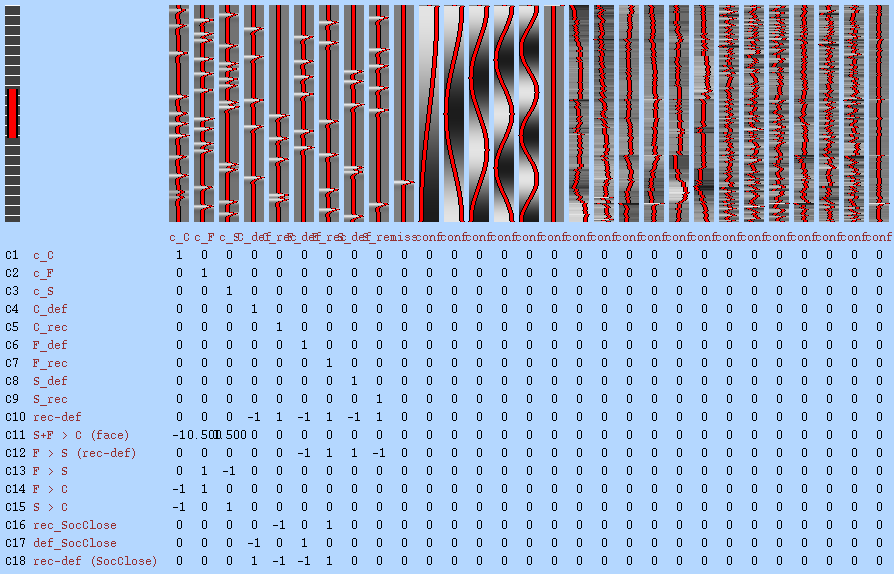
Optional: try a quick NiiVue visualization
This cell overlays a thresholded FEAT result on the example functional image from the same run.
Here we use thresh_zstat10.nii.gz, which corresponds to reciprocate > defect. In this task, that contrast is roughly reward-related, so even in a single run you may see activation in the ventral striatum and nearby reward-sensitive regions.
A few learning notes:
example_func.nii.gzgives you a background image in the same space as the FEAT results, but it’s a little blurryMNI152_T1_2mm_brain.nii.gzis a T1 background in MNI space and should be better for visualization.thresh_zstat10.nii.gzis already thresholded, so the overlay is easier to interpretif your notebook shows nothing, first confirm that the
.featdirectory exists and thatthresh_zstat10.nii.gzis really there
from pathlib import Path
from IPython.display import display
from ipyniivue import NiiVue
import nibabel as nib
import numpy as np

# FEAT background and contrast map from the same run
# bg = str(feat_dir / "example_func.nii.gz")
bg = "/cvmfs/neurodesk.ardc.edu.au/containers/fsl_6.0.7.16_20250131/fsl_6.0.7.16_20250131.simg/opt/fsl-6.0.7.16/data/standard/MNI152_T1_2mm_brain.nii.gz"
zmap = str(feat_dir / "thresh_zstat10.nii.gz")  # reciprocate > defect

print("Background exists:", Path(bg).exists(), bg)
print("Contrast exists:", Path(zmap).exists(), zmap)

if Path(bg).exists() and Path(zmap).exists():
    # Load the EPI background and choose a sensible display window
    epi = nib.load(bg).get_fdata()
    epi_nonzero = epi[epi > 0]

    lo = float(np.percentile(epi_nonzero, 2))
    hi = float(np.percentile(epi_nonzero, 98))

    nv = NiiVue()
    nv.load_volumes([
        {
            "path": bg,
            "name": "example_func",
            "colormap": "gray",
            "opacity": 1.0,
            "cal_min": lo,
            "cal_max": hi
        },
        {
            "path": zmap,
            "name": "reciprocate > defect",
            "colormap": "red",
            "opacity": 0.45
        }
    ])
    display(nv)
else:
    print("Run FEAT first, then come back to this cell.")
Background exists: True /cvmfs/neurodesk.ardc.edu.au/containers/fsl_6.0.7.16_20250131/fsl_6.0.7.16_20250131.simg/opt/fsl-6.0.7.16/data/standard/MNI152_T1_2mm_brain.nii.gz
Contrast exists: True /home/jovyan/trust_example/derivatives/fsl/sub-104/L1_task-trust_model-01_type-act_run-01_sm-6.feat/thresh_zstat10.nii.gz
Dependencies in Jupyter/Python
Using the package watermark to document system environment and software versions used in this notebook, alongside the Neurodesktop version extracted from the
JUPYTER_IMAGEorNEURODESKTOP_VERSIONenvironment variables.
import os

%load_ext watermark

%watermark
%watermark --iversions

neurodesktop_version = (
    os.environ.get('JUPYTER_IMAGE', '').split(':')[-1] or
    os.environ.get('NEURODESKTOP_VERSION', 'unknown')
)

print(f"Neurodesktop version: {neurodesktop_version}")
Last updated: 2026-10-08T16:25:51.375158+00:00
Python implementation: CPython
Python version : 3.13.15
IPython version : 9.17.1
Compiler : GCC 15.3.0
OS : Linux
Release : 6.8.0-111-generic
Machine : x86_64
Processor : x86_64
CPU cores : 16
Architecture: 64bit
IPython : 9.17.1
ipyniivue: 2.4.4
nibabel : 5.4.2
numpy : 2.5.3
pandas : 3.0.6
Neurodesktop version: 2026-10-05
- Fareri, D. S., Hackett, K., Tepfer, L. J., Kelly, V., Henninger, N., Reeck, C., Giovannetti, T., & Smith, D. V. (2022). Age-related differences in ventral striatal and default mode network function during reciprocated trust. NeuroImage, 256, 119267. 10.1016/j.neuroimage.2022.119267