Run this notebook
Preprocessing diffusion MRI
Date: 15 July 2026
License:
Note: If this notebook uses neuroimaging tools from Neurocontainers, those tools retain their original licenses. Please see Neurodesk citation guidelines for details.
✨ Use of AI ▽
This notebook was drafted with assistance from an LLM (GLM-5.2, via Neurodesk) and then revised by the author. The author reviewed the final content and takes responsibility for it.
Citation and Resources:
Tools included in this workflow
QSIPrep:
Cieslak, M., Cook, P.A., He, X. et al. QSIPrep: an integrative platform for preprocessing and reconstructing diffusion MRI data. Nat Methods 18, 775–778 (2021). Cieslak et al. (2021)
Dataset
OpenNeuro:
Hannelore Aerts and Daniele Marinazzo (2018). BTC_preop. OpenNeuro Dataset ds001226
Educational resources
Load software tools and import python libraries
We load QSIPrep through the Neurodesk module system. QSIPrep bundles its own environment (FSL, ANTs, MRtrix3, FreeSurfer), so a single module load is enough.
# Load QSIPrep
import module
await module.load('qsiprep/1.0.1')
await module.list()['qsiprep/1.0.1']The base image already provides the common scientific Python packages (see the Neurodesktop Dockerfile). Only a few standard libraries are needed below.
# Import the necessary libraries
import os, base64
import json
from pathlib import Path
from IPython.display import display
from bs4 import BeautifulSoup
from IPython.display import HTML, display
FreeSurfer license
# Request a freesurfer license from https://surfer.nmr.mgh.harvard.edu/registration.html
# and store it in your homedirectory
# This is just an exampe - please replace with your license id:
!echo "Steffen.Bollmann@cai.uq.edu.au" > ~/.license
!echo "21029" >> ~/.license
!echo "*Cqyn12sqTCxo" >> ~/.license
!echo "FSxgcvGkNR59Y" >> ~/.licenseIntroduction
Overview
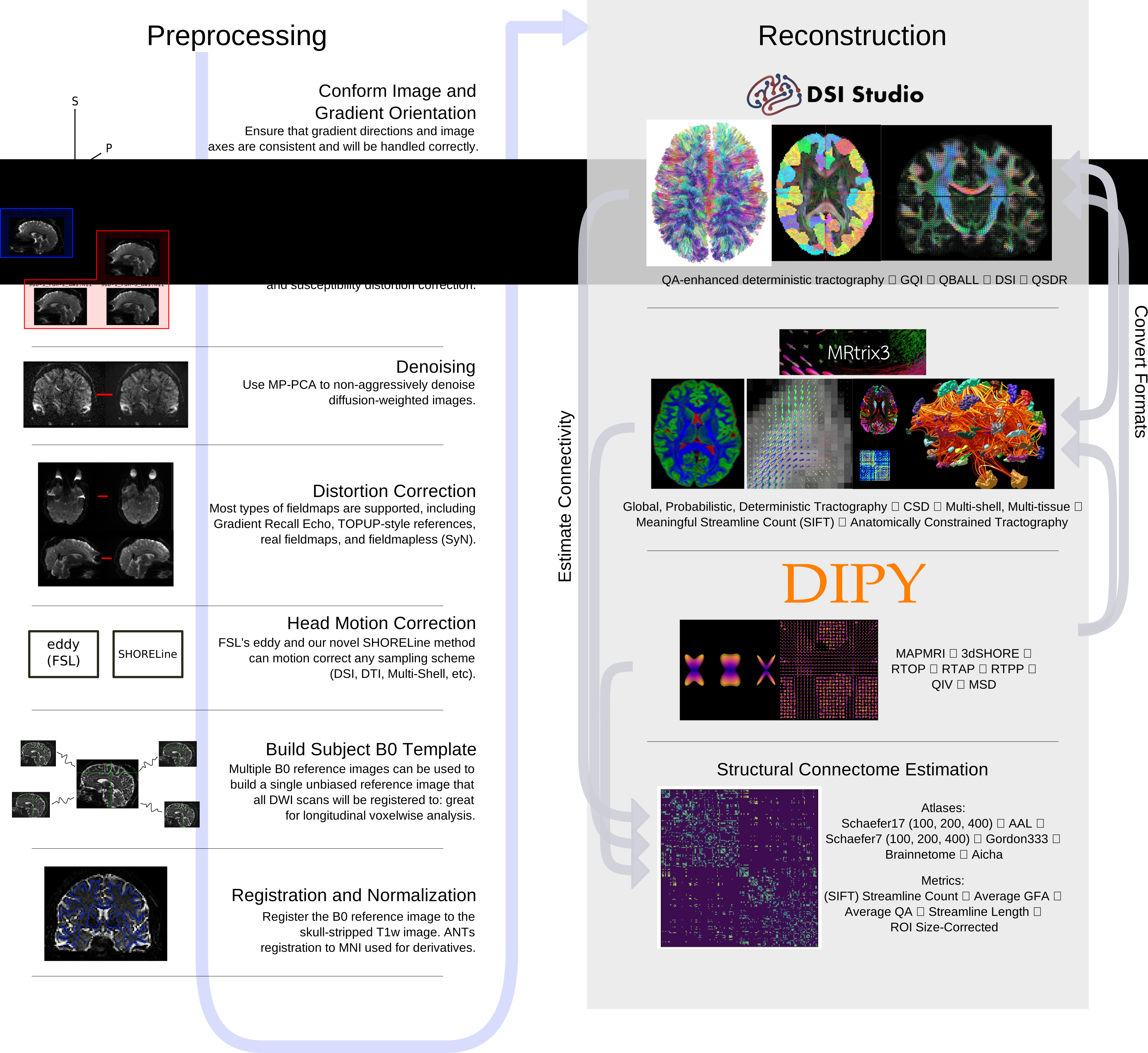
QSIPrep configures and runs preprocessing pipelines for diffusion-weighted MRI (dMRI). It’s the diffusion counterpart to fMRIPrep: a BIDS-App that combines tools from FSL, ANTs, MRtrix3 and FreeSurfer to denoise (MP-PCA), correct for susceptibility and motion, coregister to the anatomical image, optionally normalise to a template, and produce a visual QC report.
A distinguishing feature is its motion-correction algorithm (SHORELine), which works even on DSI and random q-space sampling schemes. The pipeline is assembled automatically from your BIDS inputs, so fieldmaps and multi-scan acquisitions are grouped and handled correctly. Note that “assembled automatically from your BIDS inputs” assumes the inputs follow BIDS conventions correctly. This notebook includes a preparation step: a reverse phase-encoded b=0 scan has to be set up as a fieldmap so QSIPrep can use it for distortion correction (see Prepare the reverse-PE scan for QSIPrep).
Importantly, QSIPrep only preprocesses your data. Its outputs are the preprocessed DWI series, along with their gradient tables, a brain mask, tissue segmentations, confound/QC metrics, and an HTML report summarising each step. Reconstruction — ODF/FOD estimation, tractography, connectivity — is handed off to its companion tool, QSIRecon, which consumes these derivatives. Another notebook covers that step.
QSIPrep reuses much of the fMRIPrep codebase, but this does not imply endorsement by the fMRIPrep authors.
Learning objectives
This notebook assumes a basic understanding of diffusion MRI and the BIDS layout, but no prior QSIPrep experience. By the end you will be able to:
Describe what QSIPrep does, what it deliberately leaves to reconstruction, and how it connects to QSIRecon
Load the QSIPrep module in Neurodesk and run it on a single BIDS subject
Locate and interpret the preprocessed outputs and the visual QC report
Understand how QSIPrep derivatives feed into QSIRecon for reconstruction
Data Preparation
We use the BTC preop dataset from OpenNeuro and fetch a single control subject (sub-CON01, session ses-preop). The subject contains a T1w MPRAGE (anat/), a resting-state BOLD (func/), and two DWI series in dwi/: a multi-shell HARDI acquisition (acq-AP, 101 directions, b = 0/700/1200/2800 s/mm²) and a short reverse phase-encoded scan (acq-PA, 2 volumes, both b = 0). Because the PA is a pure b0 fieldmap, QSIPrep expects it in fmap/ as an EPI file with an IntendedFor entry — we reorganise it before running QSIPrep (see below).
%%bash
set -euo pipefail
# Retry transient network failures, then fail the cell instead of continuing without data.
retry() { for i in 1 2 3 4 5; do "$@" && return 0; echo "Attempt $i failed: $*" >&2; [ "$i" -lt 5 ] && sleep $((i * 15)); done; return 1; }
# Install the dataset from GitHub using DataLad, then fetch one subject.
if [ ! -d ds001226 ]; then
  retry datalad install https://github.com/OpenNeuroDatasets/ds001226.git
fi
cd ds001226 && retry datalad get sub-CON01
[INFO] Attempting a clone into /home/jovyan/workspace/books/examples/diffusion_imaging/ds001226
[INFO] Attempting to clone from https://github.com/OpenNeuroDatasets/ds001226.git to /home/jovyan/workspace/books/examples/diffusion_imaging/ds001226
[INFO] Start enumerating objects
[INFO] Start counting objects
[INFO] Start compressing objects
[INFO] Start receiving objects
[INFO] Start resolving deltas
[INFO] Completed clone attempts for Dataset(/home/jovyan/workspace/books/examples/diffusion_imaging/ds001226)
[INFO] Remote origin not usable by git-annex; setting annex-ignore
[INFO] https://github.com/OpenNeuroDatasets/ds001226.git/config download failed: Not Found
[INFO] access to 1 dataset sibling s3-BACKUP not auto-enabled, enable with:
| datalad siblings -d "/home/jovyan/workspace/books/examples/diffusion_imaging/ds001226" enable -s s3-BACKUP
install(ok): /home/jovyan/workspace/books/examples/diffusion_imaging/ds001226 (dataset)
get(ok): sub-CON01/ses-preop/anat/sub-CON01_ses-preop_T1w.nii.gz (file) [from s3-PUBLIC...]
get(ok): sub-CON01/ses-preop/dwi/sub-CON01_ses-preop_acq-AP_dwi.nii.gz (file) [from s3-PUBLIC...]
get(ok): sub-CON01/ses-preop/dwi/sub-CON01_ses-preop_acq-PA_dwi.nii.gz (file) [from s3-PUBLIC...]
get(ok): sub-CON01/ses-preop/func/sub-CON01_ses-preop_task-rest_bold.nii.gz (file) [from s3-PUBLIC...]
get(ok): sub-CON01 (directory)
action summary:
  get (ok: 5)
Inspect the BIDS layout
Confirm the on-disk structure of sub-CON01/ses-preop and the DWI phase-encoding sidecars. These sidecars are what QSIPrep reads to decide how to perform susceptibility distortion correction (SDC).
subj = Path("ds001226/sub-CON01/ses-preop")
print("=== directory layout ===")
for d in sorted(subj.iterdir()):
    print(d.name + "/")
    for f in sorted(d.iterdir()):
        print("   ", f.name)

print("\n=== DWI phase-encoding sidecars ===")
for acq in ["AP", "PA"]:
    p = subj / "dwi" / f"sub-CON01_ses-preop_acq-{acq}_dwi.json"
    j = json.loads(p.read_text())
    bval_path = subj / "dwi" / f"sub-CON01_ses-preop_acq-{acq}_dwi.bval"
    bvals = bval_path.read_text().split()
    print(f"acq-{acq}: PhaseEncodingDirection={j['PhaseEncodingDirection']!r}  "
          f"TotalReadoutTime={j['TotalReadoutTime']}  "
          f"num_volumes={len(bvals)}  bvals={bvals}")
=== directory layout ===
anat/
sub-CON01_ses-preop_T1w.json
sub-CON01_ses-preop_T1w.nii.gz
dwi/
sub-CON01_ses-preop_acq-AP_dwi.bval
sub-CON01_ses-preop_acq-AP_dwi.bvec
sub-CON01_ses-preop_acq-AP_dwi.json
sub-CON01_ses-preop_acq-AP_dwi.nii.gz
sub-CON01_ses-preop_acq-PA_dwi.bval
sub-CON01_ses-preop_acq-PA_dwi.bvec
sub-CON01_ses-preop_acq-PA_dwi.json
sub-CON01_ses-preop_acq-PA_dwi.nii.gz
func/
sub-CON01_ses-preop_task-rest_bold.json
sub-CON01_ses-preop_task-rest_bold.nii.gz
=== DWI phase-encoding sidecars ===
acq-AP: PhaseEncodingDirection='j-' TotalReadoutTime=0.0266003 num_volumes=102 bvals=['0', '0', '700', '2800', '1200', '2800', '1200', '2800', '2800', '1200', '700', '2800', '2800', '1200', '2800', '700', '1200', '2800', '2800', '1200', '2800', '700', '2800', '1200', '2800', '1200', '0', '2800', '700', '2800', '1200', '2800', '2800', '1200', '700', '2800', '1200', '2800', '2800', '1200', '2800', '700', '2800', '1200', '2800', '1200', '2800', '700', '2800', '1200', '2800', '0', '700', '2800', '1200', '2800', '1200', '2800', '2800', '1200', '700', '2800', '2800', '1200', '2800', '700', '1200', '2800', '2800', '1200', '2800', '700', '2800', '1200', '2800', '1200', '0', '2800', '700', '2800', '1200', '2800', '2800', '1200', '700', '2800', '1200', '2800', '2800', '1200', '2800', '700', '2800', '1200', '2800', '1200', '2800', '700', '2800', '1200', '2800', '0']
acq-PA: PhaseEncodingDirection='j' TotalReadoutTime=0.0266003 num_volumes=2 bvals=['0', '0']
Prepare the reverse-PE scan for QSIPrep
The PA acquisition is 2 pure b=0 volumes (both bval = 0) with the opposite phase-encoding direction ("j") to the AP HARDI ("j-") — it is a reverse phase-encoded fieldmap, not a diffusion scan. QSIPrep’s documentation is explicit: short reverse-PE b0 scans should live in fmap/ as _epi files with an IntendedFor field pointing at the DWI they correct. If left in dwi/ as a _dwi file, QSIPrep will try to physically concatenate it with the AP HARDI — which fails because the two series were acquired separately and have slightly different spatial affines.
The fix is a simple BIDS reorganisation: copy the PA files into fmap/, rename them from _dwi to _dir-PA_epi, and add IntendedFor to the JSON sidecar. After this, QSIPrep uses the PA as a topup fieldmap for PEPOLAR SDC instead of concatenating it.
%%bash
set -e
SUBJ_DIR="ds001226/sub-CON01/ses-preop"
mkdir -p "$SUBJ_DIR/fmap"

# Copy ONLY the .nii.gz and .json (NOT bval/bvec - not valid for _epi fieldmaps)
cp "$SUBJ_DIR/dwi/sub-CON01_ses-preop_acq-PA_dwi.nii.gz" \
   "$SUBJ_DIR/fmap/sub-CON01_ses-preop_dir-PA_epi.nii.gz"
cp "$SUBJ_DIR/dwi/sub-CON01_ses-preop_acq-PA_dwi.json" \
   "$SUBJ_DIR/fmap/sub-CON01_ses-preop_dir-PA_epi.json"

# Update the EPI sidecar: add IntendedFor, ensure PhaseEncodingDirection + TotalReadoutTime present
python3 -c "
import json
p = '$SUBJ_DIR/fmap/sub-CON01_ses-preop_dir-PA_epi.json'
j = json.load(open(p))
j['IntendedFor'] = ['ses-preop/dwi/sub-CON01_ses-preop_acq-AP_dwi.nii.gz']
assert 'PhaseEncodingDirection' in j, 'PE direction missing!'
assert 'TotalReadoutTime' in j, 'TotalReadoutTime missing!'
json.dump(j, open(p, 'w'), indent=2)
print('PE:', j['PhaseEncodingDirection'], '| TRT:', j['TotalReadoutTime'], '| IntendedFor:', j['IntendedFor'])
"

# Remove the PA from dwi/ so QSIPrep doesn't try to treat it as a DWI series to concatenate
rm "$SUBJ_DIR/dwi/sub-CON01_ses-preop_acq-PA_dwi."*

echo "Reorganisation complete. fmap/ contents:"
ls "$SUBJ_DIR/fmap/"
echo "dwi/ contents:"
ls "$SUBJ_DIR/dwi/"
PE: j | TRT: 0.0266003 | IntendedFor: ['ses-preop/dwi/sub-CON01_ses-preop_acq-AP_dwi.nii.gz']
Reorganisation complete. fmap/ contents:
sub-CON01_ses-preop_dir-PA_epi.json
sub-CON01_ses-preop_dir-PA_epi.nii.gz
dwi/ contents:
sub-CON01_ses-preop_acq-AP_dwi.bval
sub-CON01_ses-preop_acq-AP_dwi.bvec
sub-CON01_ses-preop_acq-AP_dwi.json
sub-CON01_ses-preop_acq-AP_dwi.nii.gz
Analysis
We will now run QSIPrep: the command takes the BIDS dataset, an output directory, the participant analysis level, the subject label, the FreeSurfer license, and the output voxel resolution. The work directory (-w) holds intermediate files and can be deleted once the run succeeds.
%%bash
set -u -o pipefail

# FreeSurfer subjects dir must exist at startup
export SUBJECTS_DIR="$HOME/qsiprep-freesurfer-dir"
export APPTAINERENV_SUBJECTS_DIR=$SUBJECTS_DIR
export ITK_GLOBAL_DEFAULT_NUMBER_OF_THREADS=1
mkdir -p "$SUBJECTS_DIR"

# Use most (not all) of the available cores; leave 1-2 free
N_CPUS=$(nproc)
NTHREADS=$(( N_CPUS > 2 ? N_CPUS - 4 : 1 ))   # leave 1 core free
OMP_THREADS=$(( NTHREADS >= 4 ? 4 : 2 ))       # per-process cap

# Use 75% of RAM
MEM_MB=$(awk '/MemTotal/ {printf "%d", $2/1024}' /proc/meminfo)
QSIPREP_MEM=$(( MEM_MB * 75 / 100 ))

echo "Cores: ${N_CPUS} -> using ${NTHREADS} (omp ${OMP_THREADS}); RAM cap: ${QSIPREP_MEM} MB"

qsiprep ds001226 qsiprep-output participant \
    --participant-label CON01 \
    --fs-license-file ~/.license \
    --output-resolution 2 \
    -w qsiprep-work \
    --nthreads "${N_CPUS}" \
    --omp-nthreads "${OMP_THREADS}" \
    --mem-mb "${QSIPREP_MEM}" \
2>&1 | tee qsiprep.log%%bash
# Verify the results exists (preprocessed DWI, not just the report)
if ! ls qsiprep-output/sub-CON01/ses-preop/dwi/*desc-preproc_dwi.nii.gz >/dev/null 2>&1; then
echo "ERROR: QSIPrep did not produce a preprocessed DWI"; exit 1
fi
echo "QSIPrep complete - preprocessed DWI found."QSIPrep complete - preprocessed DWI found.
Where the outputs land
QSIPrep writes derivatives under qsiprep-output/:
qsiprep-output/sub-CON01.html— the visual QC report.qsiprep-output/sub-CON01/ses-preop/dwi/sub-CON01_ses-preop_acq-AP_space-ACPC_desc-preproc_dwi.nii.gz— the preprocessed DWI (with matching.bval,.bvec,.json).qsiprep-output/sub-CON01/ses-preop/dwi/sub-CON01_ses-preop_acq-AP_space-ACPC_desc-brain_mask.nii.gz— the DWI brain mask.qsiprep-output/sub-CON01/anat/sub-CON01_space-ACPC_desc-preproc_T1w.nii.gz— the preprocessed T1w.qsiprep-output/sub-CON01/anat/sub-CON01_space-ACPC_desc-aseg_dseg.nii.gz— the anatomical segmentation.
Results
We’ll display the full QC report qsiprep-output/sub-CON01.html below:
# Helper function to display the qsiprep report with inline figures and gifs
def display_report(report_path):

    report_dir = os.path.dirname(report_path)
    with open(report_path) as f:
        soup = BeautifulSoup(f, 'html.parser')

    # Inline <img> tags: PNG as base64, SVG, gif embedded directly
    for img in soup.find_all('img'):
        src = img.get('src', '')
        if not src:
            continue
        img_path = os.path.join(report_dir, src.lstrip('./'))
        if os.path.exists(img_path):
            if src.endswith('.svg'):
                with open(img_path) as f:
                    svg_tag = BeautifulSoup(f.read(), 'html.parser').find('svg')
                    if svg_tag:
                        img.replace_with(svg_tag)
            elif src.endswith('.png'):
                with open(img_path, 'rb') as f:
                    img['src'] = f'data:image/png;base64,{base64.b64encode(f.read()).decode()}'
            elif src.endswith('.gif'):
                with open(img_path, 'rb') as f:
                    img['src'] = f'data:image/gif;base64,{base64.b64encode(f.read()).decode()}'

    # Inline <object data="...svg"> tags (these were missing before!)
    for obj in soup.find_all('object'):
        data = obj.get('data', '')
        if data.endswith('.svg'):
            obj_path = os.path.join(report_dir, data.lstrip('./'))
            if os.path.exists(obj_path):
                with open(obj_path) as f:
                    svg_tag = BeautifulSoup(f.read(), 'html.parser').find('svg')
                    if svg_tag:
                        obj.replace_with(svg_tag)

    # Remove ALL tags that can execute scripts, load external resources,
    # or clutter the output. This prevents Jupyter Lab DOM interference.
    for tag in soup.find_all(['script', 'link', 'style', 'meta', 'head',
                              'nav', 'button', 'noscript', 'title']):
        tag.decompose()

    # The figures are inlined above, so drop the report's "Get figure file: <link>" lines:
    # they point into qsiprep-output/, which is not published with this page, and would 404.
    for small in soup.find_all('small'):
        if small.get_text().startswith('Get figure file'):
            small.decompose()

    # Unwrap <html> and <body> — keep their children, drop the wrapper tags
    for tag in soup.find_all(['html', 'body']):
        tag.unwrap()

    # QSIPrep's methods text links a docs page that no longer exists; point it at the
    # pipeline description in the docs for the QSIPrep version loaded above (1.0.1).
    html = str(soup).replace('https://qsiprep.readthedocs.io/en/latest/workflows.html',
                             'https://qsiprep.readthedocs.io/en/1.0.1/preprocessing.html')
display(HTML(html))display_report('./qsiprep-output/sub-CON01.html')Dependencies in Jupyter/Python
Using the package watermark to document system environment and software versions used in this notebook, alongside the Neurodesktop version extracted from the
JUPYTER_IMAGEorNEURODESKTOP_VERSIONenvironment variables.
import os

%load_ext watermark

%watermark
%watermark --iversions

neurodesktop_version = (
    os.environ.get('JUPYTER_IMAGE', '').split(':')[-1] or
    os.environ.get('NEURODESKTOP_VERSION', 'unknown')
)

print(f"Neurodesktop version: {neurodesktop_version}")
Last updated: 2026-10-08T16:40:43.435959+00:00
Python implementation: CPython
Python version : 3.13.15
IPython version : 9.17.1
Compiler : GCC 15.3.0
OS : Linux
Release : 6.8.0-111-generic
Machine : x86_64
Processor : x86_64
CPU cores : 16
Architecture: 64bit
IPython: 9.17.1
bs4 : 4.15.0
json : 2.0.9
Neurodesktop version: 2026-10-05
- Cieslak, M., Cook, P. A., He, X., Yeh, F.-C., Dhollander, T., Adebimpe, A., Aguirre, G. K., Bassett, D. S., Betzel, R. F., Bourque, J., Cabral, L. M., Davatzikos, C., Detre, J. A., Earl, E., Elliott, M. A., Fadnavis, S., Fair, D. A., Foran, W., Fotiadis, P., … Satterthwaite, T. D. (2021). QSIPrep: an integrative platform for preprocessing and reconstructing diffusion MRI data. Nature Methods, 18(7), 775–778. 10.1038/s41592-021-01185-5